The lioness emerged from the grass ten meters from our vehicle, her coat the same gold as the dry savanna, her eyes fixed on a herd of wildebeest that was grazing two hundred meters away. She moved slowly, placing each paw with precision, her belly low to the ground. I had my camera trained on her, my finger on the shutter, my breathing shallow. The light was perfect: early morning, low and warm, casting long shadows and rim-lighting her maneless head. She paused, tensed, and then the wildebeest spooked. The moment was gone. I had taken forty-seven frames. Maybe three would be sharp. That is wildlife photography: hours of waiting, seconds of action, and a hit rate that would get you fired from any other genre.
The Gear for Safari Photography
Wildlife photography in the Serengeti demands long lenses and fast shutters. I used a 200-600mm zoom lens on a full-frame body, which gave me the reach to photograph animals at a distance without disturbing them. A 1.4x teleconverter extended the range to 840mm, though at the cost of one stop of light. I carried two camera bodies, one with the long lens and one with a 24-70mm for landscapes and environmental shots. A bean bag, placed on the vehicle's window frame, provided more stability than a tripod in the confined space of a safari Land Cruiser. Memory cards were essential: I shot three thousand frames in five days and filled two 128-gigabyte cards. I also carried a laptop and two external drives for backup. Losing a day's photographs in the Serengeti is not an option.
The Great Migration
I timed my visit to coincide with the Great Migration, the annual movement of two million wildebeest, zebras, and gazelles across the Serengeti-Mara ecosystem. The crossing of the Mara River is the most dramatic spectacle: thousands of animals plunge into crocodile-infested water, swimming against the current while predators wait on the banks. I witnessed two crossings. The first was chaotic, dust-filled, and almost impossible to photograph well because the action was spread across a kilometer of riverbank. The second was smaller but more focused: a group of three hundred wildebeest crossed at a narrow point, and I was positioned on a cliff above, looking down at the churning water and the animals struggling against the current. The photograph I made there, of a wildebeest mid-leap with the river below and the sky above, is the best wildlife image I have ever taken.
Light and Landscape
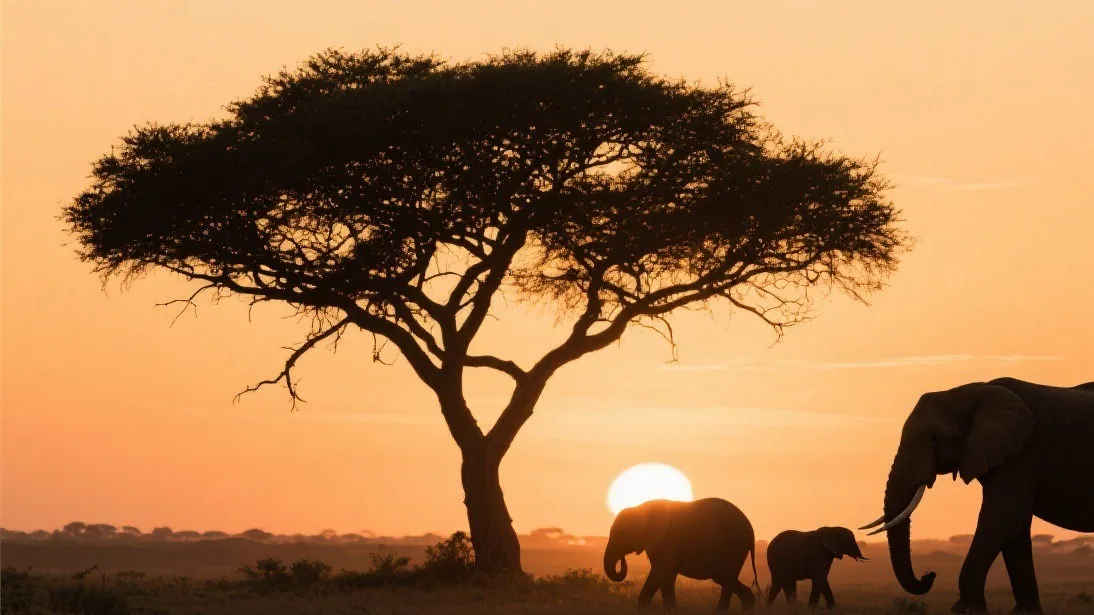
The Serengeti is not just about animals. The landscape itself is a subject, especially at dawn and dusk when the acacia trees cast long shadows across the plains. I woke before sunrise every day to photograph the sky as it changed from indigo to orange to blue. One morning, a lone elephant walked across the horizon, silhouetted against the rising sun. I had time for six frames before he disappeared behind a termite mound. The image is simple: a black shape against a gold sky. But the scale of the elephant against the vastness of the plain conveys something that a close-up portrait cannot: the feeling of space that defines the Serengeti.
The Ethics of Wildlife Photography
Wildlife photography has an ethical dimension that is often ignored. In the Serengeti, the rules are clear: stay on designated roads, do not approach animals closer than twenty meters, and never interfere with a hunt or a kill. I saw photographers break all three rules. One driver positioned his vehicle between a cheetah and her prey, hoping to force a confrontation. Another used a drone, which is illegal in Tanzanian national parks and stresses the animals. I reported both incidents to park authorities. The Serengeti is not a zoo. The animals are wild, and their welfare must come before any photograph. I left the Serengeti with thousands of images and a renewed commitment to ethical practice. The best wildlife photograph is the one that was taken without causing harm.