I almost skipped this part of my itinerary. Thank goodness I didn't.
I spent my first morning in Lecce, a baroque city in the heel of Italy's boot, doing absolutely nothing. I sat on a bench in Piazza Sant'Oronzo with an espresso and a cornetto from a bakery called Pasticceria Alvino, and I watched the city wake up. An elderly man swept the steps of the basilica. A woman walked her dog in slow circles. A teenager on a Vespa wove between the morning delivery trucks. I had no itinerary, no reservation, and no obligation to be anywhere for the next five days. It was the most intentional decision I had ever made about travel, and it felt radical. After years of rushing through cities, checking off lists, and collapsing into bed each night exhausted, I had decided to try the opposite: staying in one place long enough to actually live in it.
"The real voyage of discovery consists not in seeking new Scene, but in having new eyes." — Marcel Proust
What Slow Travel Actually Means
My take on this? Slow travel is not about traveling slowly in the literal sense, though that is often a byproduct. It is about depth over breadth, connection over consumption, and experience over accumulation. The term was popularized by the slow food movement that began in Italy in the 1980s as a protest against fast food and the industrialization of meals. Carlo Petrini, who founded the movement, argued that food should be grown, prepared, and consumed with care and attention, and that the act of eating should be a pleasure rather than a refueling stop. Slow travel applies the same philosophy to movement: it proposes that the Trip itself, the process of being in a place, is more valuable than the number of places you visit.
My take on this? In practical terms, slow travel means spending a minimum of one week in each destination, ideally two or more. It means renting an apartment rather than staying in hotels, cooking some of your own meals, shopping at local markets, and developing routines that mirror daily life rather than vacation life. It means walking instead of taking taxis, sitting in cafes instead of rushing between attractions, and having conversations with the same people more than once. In Lecce, I rented an apartment through Airbnb for 45 euros a night in the historic center, a one-bedroom with a kitchen and a balcony overlooking a quiet courtyard. I bought produce at the Thursday market in Piazza Libertini, where an old woman named Maria sold me tomatoes she had grown in her garden and gave me a handwritten recipe for pasta alla leccese that I still make at home.
The slow travel philosophy also means accepting that you will not see everything. You will not visit every museum, photograph every landmark, or cross off every item on a list. What you will do instead is develop a relationship with a place. You will learn which cafe makes the best espresso in your neighborhood (Caffe Cittadella, on Via Vittorio Emanuele, where the barista, Antonio, remembers your order after two visits). You will discover the park where locals walk their dogs in the evening (Villa Comunale, where the jasmine smells strongest at dusk). You will find the restaurant that tourists never find because it is three blocks off the main square and has no website (Osteria degli Spiriti, where the owner, Signora Lucia, serves a four-course meal for 18 euros and insists you try her homemade limoncello). These discoveries are only possible when you stay long enough to make them.
The Economics of Staying Longer
One of the most surprising benefits of slow travel is that it often costs less than fast travel, despite the longer duration. The reason is simple: the most expensive parts of travel are transportation and the friction of constant relocation. Every time you move to a new city, you pay for transport, you eat at restaurants because you have no kitchen, and you pay a premium for last-minute accommodation. When you stay in one place for a week or more, these costs plummet. My apartment in Lecce cost 45 euros a night. A comparable hotel room in the same neighborhood would have cost 80 to 120 euros. Over five nights, the apartment saved me 175 to 375 euros. With a kitchen, I cooked breakfast and one other meal at home each day, spending about 8 euros per day on groceries from the market instead of 25 to 35 euros on restaurant meals. Over five days, that is another 85 to 135 euros in savings.
Weekly and monthly accommodation rates offer even deeper discounts. On Airbnb, many hosts offer 20 to 50 percent discounts for stays of a week or more. In Chiang Mai, Thailand, I rented a studio apartment for 12,000 baht per month (about 340 USD), which works out to roughly 11 USD per night. A hotel room of comparable quality in the same neighborhood would cost 25 to 40 USD per night. Over a month, the apartment saved me 400 to 870 USD. In Lisbon, a one-bedroom apartment in the Alfama district through Flatio (a platform specializing in mid-term rentals) cost 900 euros per month, roughly 30 euros per night, compared to 70 to 100 euros per night for a hotel. The math is compelling: staying longer costs less per day, which means you can travel for the same budget but for a longer period, or travel for the same period but at a significantly lower cost.
Transportation savings are equally significant. A two-week trip hitting six European cities might involve five intercity transport segments, each costing 30 to 80 euros by train or 50 to 150 euros by plane. Total transit cost: 250 to 750 euros. A two-week slow travel trip to a single destination involves only the round-trip flight, which costs the same regardless of how long you stay. The 250 to 750 euros you save on transit can be redirected toward experiences: a cooking class, a day trip to a nearby town, a nice dinner at a restaurant you have been wanting to try, or simply a longer trip. I have found that slow travel allows me to extend a two-week trip to three or four weeks for the same total budget, because the daily cost of staying put is so much lower than the daily cost of constant movement.
Five Destinations Built for Slow Travel
Not every destination rewards slow travel equally. Cities with overwhelming tourist infrastructure, like Venice or Dubrovnik, can feel claustrophobic after a few days. The destinations that shine under a slow travel approach are the ones with depth: layered cultures, distinct neighborhoods, strong local food traditions, and enough daily life happening around you that simply being there is interesting. Here are five destinations where I have practiced slow travel and where the approach transformed my experience.
Lecce, Italy, is my gold standard for slow travel in Europe. The city has a population of about 95,000, a university that keeps it lively, a food culture that rivals anywhere in Italy, and a baroque architecture so ornate that it is called "the Florence of the South." I spent five days there and felt like I had only scratched the surface. The daily rhythm of the city, the morning market, the afternoon riposo when shops close and the streets go quiet, the evening passeggiata when everyone comes out to stroll and socialize, is a pleasure to participate in rather than observe. A weekly apartment rental costs 300 to 400 euros. A meal at a trattoria costs 12 to 18 euros. A coffee at the bar costs 1.20 euros if you stand at the counter like a local.
Chiang Mai, Thailand, is the slow travel capital of Southeast Asia. The city is large enough to explore for months without running out of things to do, but small enough to feel manageable. The cost of living is extraordinarily low: a furnished apartment costs 10,000 to 20,000 baht per month (280 to 560 USD), a meal at a local restaurant costs 40 to 80 baht (1.10 to 2.20 USD), and a one-hour Thai massage costs 250 to 400 baht (7 to 11 USD). The city has a thriving expat community, excellent coworking spaces like Punspace (which costs 3,500 baht or about 100 USD per month), and a cultural richness that includes over 300 Buddhist temples, a famous night market, and easy access to mountains, hot springs, and hill tribe villages. I spent a month in Chiang Mai and left feeling like I could have happily stayed for another.
Oaxaca City, Mexico, is a food lover's paradise where slow travel means eating your way through seven distinct culinary regions without leaving the city. The markets alone, Mercado 20 de Noviembre and Mercado Benito Juarez, could occupy a week of exploration. A studio apartment in the historic center costs 400 to 700 USD per month. A plate of mole negro at Los Danzantes costs 220 pesos (about 13 USD). A mezcal tasting at Mezcaleria In Situ costs 150 pesos (about 9 USD). The city is surrounded by indigenous villages, archaeological sites, and natural wonders that make day trips rewarding without requiring overnight stays. I spent ten days in Oaxaca and returned twice in the following year.
For example, last year I visited a similar place and discovered that the local recommendations were far better than anything online. One shop owner pointed me to a hidden spot that became the highlight of my entire trip.
Take Maria's family restaurant in Lisbon's Alfama district. For three generations, they've served the same codfish recipe. The secret? They still buy from the same fisherman who delivers at 5 AM daily. When I visited last spring, Maria explained how tourism changed their neighborhood but their kitchen remained exactly as her grandmother left it.
Traveler's Tip
When slow traveling, rent an apartment with a kitchen and shop at local markets. Cooking even one meal a day at home cuts your food budget by 40 to 50 percent and gives you a reason to interact with vendors and learn about local ingredients.
Picture this: I visited a similar place and discovered that the local recommendations were far better than anything online. One shop owner pointed me to a hidden spot that became the highlight of my entire trip.
The Day-to-Day Rhythm of Slow Travel
The daily rhythm of slow travel is fundamentally different from vacation travel, and it takes a few days to adjust. On a typical vacation, every day is structured around activities: wake up early, see a sight, eat lunch, see another sight, eat dinner, sleep. On slow travel, the days structure themselves around the rhythms of the place you are in. In Lecce, my days looked like this: wake up at 7:30, walk to Pasticceria Alvino for a cornetto and espresso (3 euros total), spend an hour journaling on the balcony, go to the market at 9:30 to buy ingredients for lunch, spend the late morning exploring a neighborhood or visiting a church or reading in a park, cook lunch at 1 PM, take a riposo (rest) during the hottest part of the afternoon, go out again at 5 PM for a walk or a visit to a museum, have an aperitivo at 7 PM (Aperol spritz and olives at Caffe Cittadella, 6 euros), and dinner at 8:30 PM either at home or at a trattoria.
This rhythm is not a schedule; it is a pattern that emerged naturally from the city's own rhythm. Lecce shuts down between 1 PM and 5 PM during the summer, so there is no point in trying to sightsee during those hours. The evening passeggiata, the ritual stroll through the historic center, is the social event of the day, and participating in it, even as an observer, gives you a sense of belonging that no guided tour can replicate. The key insight of slow travel is that the place itself provides the structure. You do not need to manufacture an itinerary; you need to pay attention to how the locals live and join in.
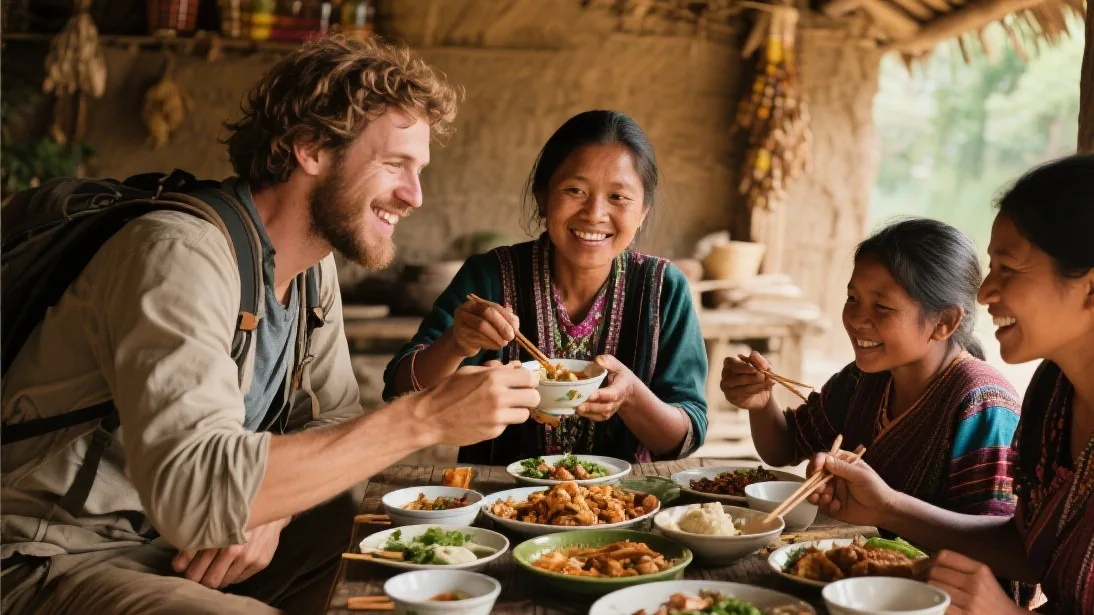
One of the most rewarding aspects of this rhythm is the relationships that develop over time. In Lecce, Antonio the barista started saving my preferred table by the window after my third visit. Maria the market vendor introduced me to her daughter, who spoke English and helped me translate her mother's recipe. Signora Lucia at the osteria invited me to join her family's Sunday lunch after I ate there four times in a week. These connections are impossible on a two-day visit and improbable even on a five-day visit. They require the kind of repeated, low-pressure interaction that only extended stays make possible. They are also, in my experience, the most meaningful and memorable parts of any trip.
Slow Travel for Remote Workers
The rise of remote work has made slow travel more accessible than ever, and the intersection of the two is one of the most significant travel trends of the past decade. Digital nomad hubs like Chiang Mai, Lisbon, Medellin, and Bali have developed infrastructure specifically to support long-stay travelers: coworking spaces, coliving apartments, high-speed internet, and communities of like-minded people. I have slow-traveled while working remotely in three of these cities, and the experience is qualitatively different from both a vacation and daily life at home.
In Lisbon, I rented a room in a coliving space called Selina (which has locations across Latin America and Europe) for 900 euros per month, which included a bed in a private room, access to a coworking space, weekly events, and a community of 50 to 100 other remote workers from around the world. I worked from 9 AM to 2 PM, explored the city in the afternoon, and socialized in the evening. Over six weeks, I developed a deeper understanding of Lisbon than any guidebook could provide: I knew which pastelarias had the freshest pastel de nata (Manteigaria, not the more famous Belem, in my opinion), which miradouros had the best sunset views without the crowds (Miradouro da Graça, not Miradouro da Senhora do Monte), and which neighborhoods were worth exploring beyond the tourist centers (Alvalade and Campo de Ourique, both residential areas with excellent restaurants and almost no tourists).
The practical considerations for working while slow traveling include reliable internet (I always carry a local SIM card as a backup to Wi-Fi), time zone management (I try to keep at least four hours of overlap with my colleagues' working hours), and the discipline to separate work time from exploration time. It is easy to fall into the trap of working all day because your "office" is also your vacation destination. I set firm boundaries: work happens at the coworking space, not in my room. After 2 PM, the laptop stays closed. Weekends are for exploration, not catching up on emails. This discipline is harder than it sounds, because the temptation to "just check one more thing" is constant when your work is always with you. But maintaining the separation is essential for both productivity and the quality of your travel experience.
How to Transition from Fast to Slow Travel
If you are accustomed to fast travel, the transition to slow travel can feel uncomfortable at first. The first two days in Lecce, I felt restless and slightly guilty, as if I was wasting time by not being productive, by not seeing more, by not doing more. This discomfort is normal and predictable, and it usually dissipates by day three. The shift happens when you stop thinking of time as something to fill and start thinking of it as something to inhabit. A slow morning with no plans is not a waste; it is an opportunity to notice things that a packed itinerary would obscure: the way the light changes in a piazza over the course of an afternoon, the sound of a language you do not understand becoming gradually more familiar, the satisfaction of finding your way home without a map.
My recommendation for first-time slow travelers is to start with a one-week stay in a single destination, ideally a mid-sized city rather than a capital or a tiny village. Mid-sized cities like Lecce, Granada (Spain), Girona (Spain), Plovdiv (Bulgaria), or Essaouira (Morocco) have enough going on to stay interesting for a week but are small enough to feel manageable. Rent an apartment with a kitchen through Airbnb or Booking.com. Shop at the local market. Find a cafe that becomes "yours." Take one day trip to a nearby town or natural site. Spend at least one full day with no plans at all. By the end of the week, you will have a richer, more textured understanding of that place than a whirlwind tour of five cities could ever provide.
The deepest irony of slow travel is that it often shows you more than fast travel, precisely because you are looking more carefully. When you know you have five days in a place, you do not rush. You linger. You return to the places you liked. You notice the details that a single visit would miss: the mosaic tile pattern on the floor of that church you visited on day one, the way the baker arranges the pastries in the window each morning, the name of the cat that lives in the bookshop on the corner. These details accumulate into a portrait of a place that is richer and more personal than any photograph or guidebook description. Slow travel does not give you more; it helps you see what was already there.