The taxi driver asked where I was from, and our conversation became the highlight of my trip.
I spent the first four days of what was supposed to be a three-week trip to India lying on a stained mattress in a guesthouse in Varanasi, unable to keep down anything but bottled water and oral rehydration salts. The culprit was a lassi from a street vendor that I knew, in the rational part of my brain, was a risk. But it was 42 degrees Celsius, the lassi looked incredible, and every other traveler at the stall was drinking one. Three days of violent illness taught me a lesson that no travel health article had adequately conveyed: your body is your most important travel asset, and protecting it is not optional, it is the foundation on which every other travel experience depends.
"Take care of your body. It is the only place you have to live." — Jim Rohn
Building Your Travel Health Kit
My take on this? My travel health kit has evolved through trial, error, and the advice of a travel medicine doctor at the University of Washington Travel Clinic. Before any international trip, I schedule an appointment with a travel health specialist, not my regular physician, because travel medicine is a specialized field that most general practitioners do not stay current on. The consultation costs 50 to 100 USD and covers destination-specific vaccination requirements, malaria prophylaxis, and altitude sickness prevention. For my India trip, the clinic recommended typhoid and hepatitis A vaccines (both available at most travel clinics for 50 to 80 USD each), a prescription for Ciprofloxacin (an antibiotic for traveler's diarrhea, which I filled at a pharmacy for 15 USD), and Malarone for malaria prevention (about 4 USD per tablet, taken daily).
From what I've seen, The over-the-counter medications in my permanent travel kit include: Imodium (loperamide) for acute diarrhea, 20 tablets for 8 USD; Pepto-Bismol tablets for mild stomach upset, 60 tablets for 10 USD; ibuprofen 200mg for pain and inflammation, 50 tablets for 6 USD; diphenhydramine 25mg (Benadryl) for allergic reactions and as a sleep aid on long flights, 24 tablets for 5 USD; oral rehydration salts (ORS), which I buy as CeraLyte packets on Amazon, 3 USD for a box of 8; and a small tube of hydrocortisone cream 1% for insect bites and rashes, 4 USD. I also carry a digital thermometer (3 USD) because fever is a warning sign that should not be ignored, and being able to check your temperature accurately can help you decide whether to rest or seek medical attention.
One item that travelers often overlook is a basic first-aid kit. I carry a compact Adventure Medical Kits Ultralight/Watertight.7 kit (22 USD), which contains bandages, antiseptic wipes, blister treatment, medical tape, and a few other essentials in a waterproof case that weighs under 200 grams. I have used it to treat blisters on the Inca Trail, a scraped knee after a scooter accident in Bali, and a minor burn from a motorcycle exhaust pipe in Vietnam. These are not life-threatening injuries, but untreated, they can become infected in tropical climates and derail your trip. The kit takes up almost no space and provides peace of mind that is worth its weight in gold.
Food and Water Safety
The most common health issue for travelers, by a wide margin, is traveler's diarrhea, which affects 30 to 70 percent of visitors to developing countries according to the CDC. The primary cause is contaminated food and water, and the prevention strategies are straightforward even if they require discipline. For water, the rule is simple: drink only sealed bottled water, water that has been boiled for at least one minute, or water that has been treated with a purification system. I use the LifeStraw Go water bottle (35 USD), which has a built-in filter that removes bacteria and parasites from tap water. In countries where I am unsure about water quality, I also carry Aquatabs water purification tablets (10 USD for 30 tablets), each of which treats 1 liter of water in 30 minutes.
For food, the CDC recommends the mantra "boil it, cook it, peel it, or forget it." In practice, this means eating food that is served piping hot and cooked to order, avoiding buffets where food sits at room temperature, peeling all raw fruits and vegetables yourself, and avoiding raw or undercooked meat, seafood, and eggs. Street food is not inherently dangerous; in fact, some of the safest street food is prepared in front of you at high heat. The danger comes from food that has been pre-cooked and sitting around, especially in warm climates. In Thailand, I eat at street stalls where I can watch the food being cooked in a wok over high flame. In India, I avoid pre-cut fruit that has been sitting in the sun. In Mexico, I drink only bottled water even when brushing my teeth, because the tap water in many areas contains organisms that your immune system is not prepared for.
The one exception I make is for cooked food in reputable restaurants with high turnover. A busy restaurant in Bangkok that serves hundreds of meals a day is less likely to serve contaminated food than a quiet one, because the ingredients are replenished frequently and do not sit around. I look for places with lots of local customers, which is usually a sign that the food is both good and safe. The Michelin-recommended Jay Fai in Bangkok, where a single crab omelet costs 1,000 baht (about 28 USD), is technically a street stall, but the wok temperatures are so high that any bacteria are destroyed. The lesson is not "avoid street food" but "be selective about which street food you eat."
Staying Healthy on Long-Haul Flights
Long-haul flights are a health hazard that most travelers underestimate. The combination of recycled air, low humidity, prolonged immobility, and disrupted circadian rhythms can leave you arriving at your destination dehydrated, stiff, jet-lagged, and vulnerable to illness. I have developed a flight health routine over years of 12-to-16-hour flights that significantly reduces these effects. First, hydration: I drink at least 250 ml of water per hour of flight time, which means roughly 3 liters on a 12-hour flight from New York to Tokyo. I bring an empty Nalgene bottle through security and fill it at the gate. Cabin air has about 10 to 20 percent humidity, compared to 30 to 65 percent in normal environments, and this dryness causes headaches, dry skin, and fatigue that most travelers attribute to jet lag but are actually dehydration.
Second, movement: I get up from my seat every 60 to 90 minutes and walk the aisle for five minutes. On a 12-hour flight, this means six to eight short walks. I also do seated exercises every hour: ankle circles, knee lifts, shoulder rolls, and neck stretches. These movements prevent deep vein thrombosis (DVT), a blood clot condition that can be serious or even fatal, and is more common on long flights than most people realize. The risk is higher for travelers over 40, those who are overweight, those taking oral contraceptives, and those who have recently had surgery. I wear compression socks (2XU or Physix Gear, 15 to 25 USD) on all flights over four hours, which improve circulation and reduce swelling in the lower legs.
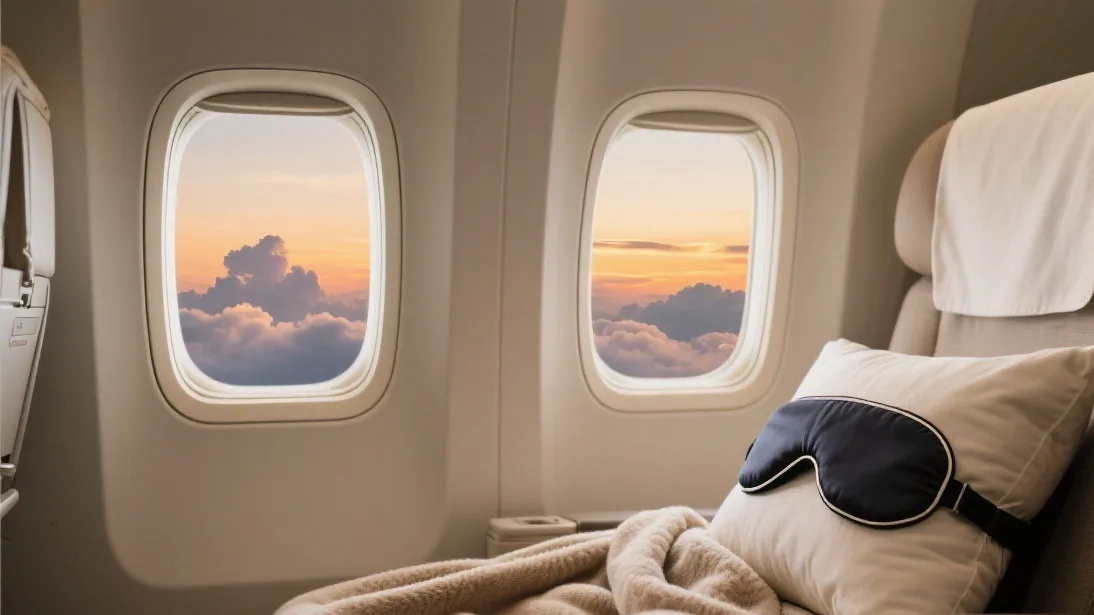
Third, sleep management: I adjust my sleep schedule toward my destination's time zone starting three days before departure, shifting by 30 minutes per day. On the flight, I set my watch to the destination time immediately and try to sleep according to that schedule. I use a sleep mask (Manta Sleep Mask, 30 USD, which has adjustable eye cups that do not press on your eyelids) and earplugs (Loop Quiet, 25 USD, which reduce noise without completely blocking it, allowing you to hear announcements). I avoid alcohol on flights, because it dehydrates you and disrupts sleep quality. I also avoid heavy meals, opting for lighter options and bringing my own snacks like nuts, dried fruit, and a protein bar. Melatonin (3 mg, available over the counter for 8 USD for a bottle of 60) taken 30 minutes before desired sleep time can help reset your circadian rhythm, but I use it sparingly, no more than three nights in a row, to avoid dependency.
Traveler's Tip
Start taking probiotics two weeks before your trip and continue throughout. A 2019 study in the journal Travel Medicine and Infectious Disease found that travelers who took probiotics were 40 percent less likely to develop traveler's diarrhea. I use Culturelle Digestive Health (20 USD for 30 capsules).
Vaccinations and Travel Medicine
Vaccination requirements vary dramatically by destination, and the consequences of skipping them range from inconvenient to life-threatening. The CDC's travel health website (cdc.gov/travel) maintains a country-by-country database of recommended and required vaccinations that I consult before every trip. For Southeast Asia, the recommended vaccines include hepatitis A, typhoid, and tetanus (booster every 10 years). For Sub-Saharan Africa, add yellow fever (required for entry into many countries), meningitis, and rabies pre-exposure (especially if you will be in rural areas or working with animals). For South America, add yellow fever and consider Japanese encephalitis if visiting rural areas.
Consider what happened when I visited a similar place and discovered that the local recommendations were far better than anything online. One shop owner pointed me to a hidden spot that became the highlight of my entire trip.
Look at what happened in Iceland last year. The popular Golden Circle route became so crowded that locals started sharing alternative paths. A farmer named Gunnar opened his private land for small groups. His hot spring, unknown to most tourists, offers a view of the northern lights that rivals any expensive tour.
Timing matters. Most vaccines take two to four weeks to reach full effectiveness, so you should schedule your travel health appointment at least six weeks before departure. Some vaccines require multiple doses: the rabies pre-exposure series is three doses over 21 to 28 days, and the Japanese encephalitis series is two doses over 28 days. If you are planning a last-minute trip, some travel clinics offer accelerated schedules, but these are not available for all vaccines. The cost of travel vaccines varies: hepatitis A is 50 to 80 USD per dose, typhoid is 35 to 50 USD, yellow fever is 150 to 200 USD, and rabies pre-exposure is 200 to 300 USD for the full series. Many health insurance plans do not cover travel vaccines, so check with your provider before your appointment.
Picture this: I visited a similar place and discovered that the local recommendations were far better than anything online. One shop owner pointed me to a hidden spot that became the highlight of my entire trip.
Malaria prevention is a separate consideration for travel to tropical regions in Africa, Southeast Asia, and South America. The most common prophylactic is Malarone (atovaquone-proguanil), taken daily starting one to two days before entering a malaria zone and continuing for seven days after leaving. It costs about 4 to 6 USD per tablet, and a two-week supply costs 56 to 84 USD. Side effects are generally mild but can include vivid dreams and nausea. Doxycycline is a cheaper alternative (about 1 USD per tablet) but requires daily dosing and makes you photosensitive. I have taken Malarone for trips to Tanzania, Cambodia, and the Amazon, and the only side effect I experienced was unusually vivid dreams, which I actually found entertaining. The alternative, contracting malaria, is not entertaining at all.
Managing Jet Lag and Sleep Disruption
Jet lag is the most predictable health challenge of international travel, and the most poorly managed by most travelers. The standard advice, "force yourself to stay awake until bedtime at your destination," is too simplistic and often counterproductive. A more effective approach, based on research from the Stanford Sleep Medicine Center, involves three strategies: light exposure, meal timing, and strategic napping. Light is the most powerful circadian signal. If you travel east, seek bright light exposure in the morning at your destination and avoid it in the evening. If you travel west, seek light in the evening and avoid it in the morning. On a trip from New York to Tokyo, a 14-hour time difference east, I spend the first morning in Tokyo walking outside in direct sunlight for at least 30 minutes, and I wear blue-light-blocking glasses (Swanwick, 40 USD) after 6 PM to help my body recognize that evening has arrived.
Meal timing is the second circadian signal, and it is one that most travelers ignore. Your digestive system has its own clock, and eating meals at the wrong time can prolong jet lag. I start shifting my meal times toward my destination's schedule two to three days before departure. On the flight, I eat according to the destination's meal times, not the departure city's. If it is breakfast time in Tokyo, I eat breakfast even if my body thinks it is dinnertime in New York. This sounds minor, but research published in the journal Cell in 2019 found that meal timing was as effective as light exposure in resetting circadian rhythms, and combining both was more effective than either alone.
Strategic napping is the third tool, and it requires more nuance than "take a nap when you are tired." Long naps during the day at your destination reinforce your old time zone and make it harder to adjust. Short naps of 20 minutes or less, called "power naps," can restore alertness without affecting nighttime sleep. I set an alarm for exactly 20 minutes when I nap, and I nap before 3 PM local time. After 3 PM, I push through the fatigue with light physical activity: a walk, some stretching, or even a few flights of stairs. Caffeine is useful but should be avoided within six hours of your target bedtime at the destination. I drink coffee in the morning and switch to decaf or herbal tea after 2 PM. It takes most people about one day per time zone crossed to fully adjust, so a trip across six time zones will take roughly a week to feel completely normal.
Travel Insurance: Non-Negotiable
I once met a woman in a hospital in Cusco, Peru, who had broken her leg on the Inca Trail and was facing a 15,000 USD medical evacuation bill because she had decided to "save money" by skipping travel insurance. Her evacuation alone, a helicopter ride from the trail to a hospital in Lima, cost more than her entire trip would have cost with insurance. I use World Nomads travel insurance (worldnomads.com), which costs 6 to 10 USD per day depending on your destination, coverage level, and age. Their Explorer plan covers emergency medical expenses up to 5 million USD, emergency evacuation up to 1 million USD, trip cancellation, lost luggage, and 24/7 emergency assistance.
When comparing travel insurance policies, I look for four specific coverages. First, emergency medical coverage with a high limit (at least 250,000 USD, ideally 1 million or more). Medical costs in the U.S. are astronomical, but even in countries with cheaper healthcare, emergency treatment and evacuation can be staggeringly expensive. Second, emergency evacuation coverage, which pays for transport to the nearest adequate medical facility or repatriation to your home country. Third, trip cancellation and interruption coverage, which reimburses prepaid, non-refundable trip costs if you have to cancel or cut short your trip due to illness, injury, or family emergency. Fourth, coverage for pre-existing conditions, which many basic policies exclude. World Nomads covers pre-existing conditions if you declare them and purchase the policy within 14 days of your initial trip payment.
I also carry a physical copy of my insurance policy and the emergency assistance phone number in my travel wallet, and I save a digital copy to my phone. When I had to visit a clinic in Chiang Mai for a sinus infection, I called the World Nomads emergency line, and they directed me to a partner clinic, communicated with the doctor on my behalf (in Thai), and arranged direct billing so I did not have to pay out of pocket and file a claim later. The entire process took 15 minutes, and I was treated within an hour. Without insurance, I would have paid 3,000 baht (about 85 USD) out of pocket and Explore the Thai healthcare system alone, which would have been stressful and time-consuming. Travel insurance is not a luxury; it is a basic responsibility of international travel.
Mental Health on the Road
Physical health gets most of the attention in travel health discussions, but mental health is equally important and far less discussed. Solo travel is emotionally demanding in ways that are difficult to anticipate. The constant novelty is stimulating but also exhausting. The lack of routine can be disorienting. The distance from your support network can Boost anxiety and sadness. I have experienced all of these, and I have learned that maintaining mental health on the road requires the same deliberate effort as maintaining physical health.
The most effective mental health strategy I have developed is maintaining a daily routine, even a minimal one. My routine includes: waking up at roughly the same time each day (within a one-hour window), spending 20 minutes journaling in the morning, getting at least 30 minutes of physical activity (walking counts), and calling or messaging a friend or family member at a scheduled time each week. This routine provides structure and predictability in an otherwise unstructured experience, and it serves as an emotional anchor that keeps me grounded. When I feel overwhelmed, I return to my routine like a touchstone.
I also practice what psychologists call "emotional check-ins," a deliberate pause three times a day to assess how I am feeling. Morning: what is my energy level? How is my mood? Am I excited about the day ahead? Midday: am I enjoying myself, or am I pushing through out of obligation? Do I need food, water, or rest? Evening: what was the best part of the day? What was the hardest? What do I need tomorrow? These check-ins take less than a minute each but have prevented me from burning out on multiple trips. They help me catch emotional exhaustion before it becomes debilitating, and they remind me that it is okay to slow down, take a rest day, or change plans if my mental health requires it. Travel is supposed to enrich your life, not deplete it.